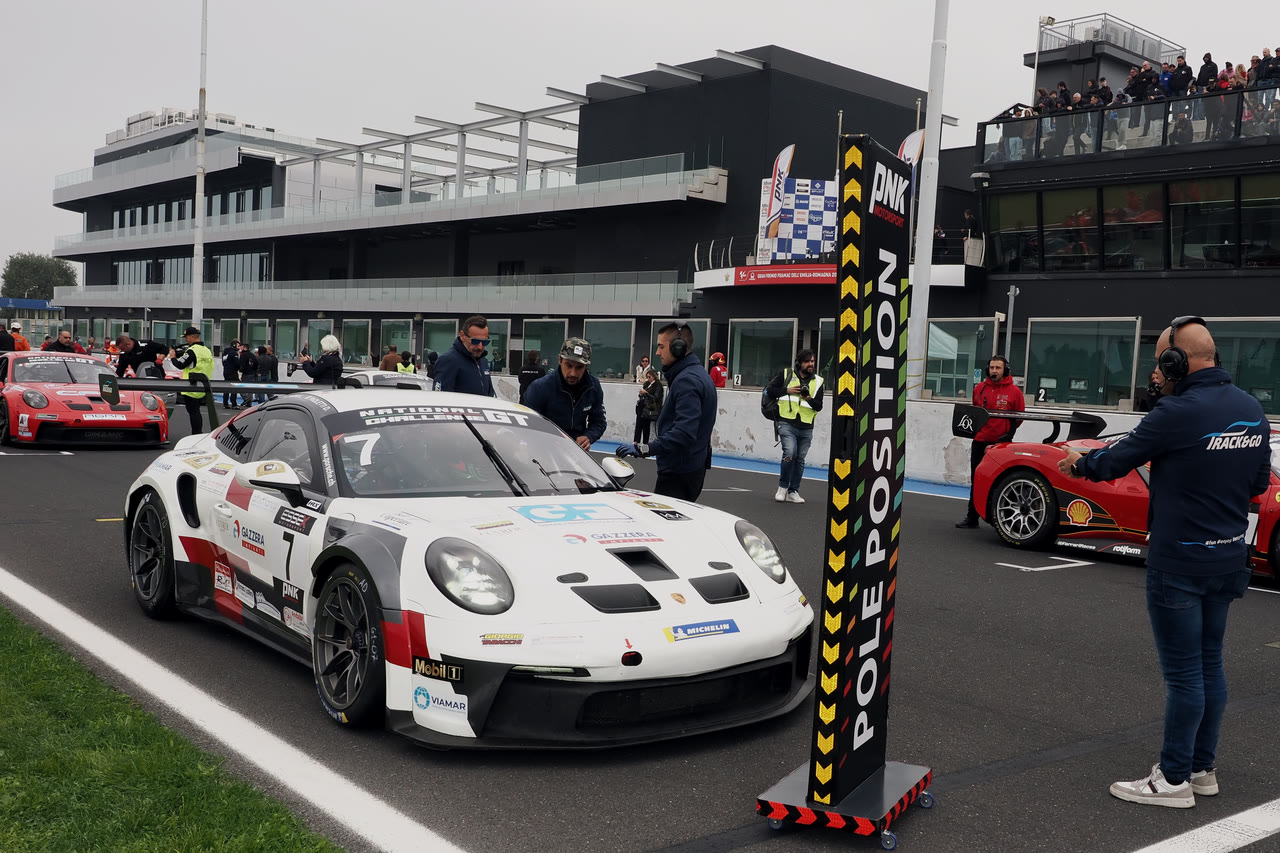

Hospitality does not create relationships; it creates an opportunity. What research and regulation say about whom to invite, how to design the day, how to protect guests and how to turn the event into a next step.
In brief
Bringing clients and investors to a circuit is an investment in relationships only when it is designed as one. A study of 189 UK companies links satisfaction with corporate hospitality to a strategic approach, deliberate matching of guests to events and formal evaluation of outcomes. Research on reciprocity shows that the effect of a generous gesture fades quickly, while anti-bribery guidance and MiFID II demand proportion. Five choices make the difference: deliberate guests, a format built for conversation, prepared hosts, confidentiality and proportion, and follow-up within days.
The thesis. Hospitality does not create relationships; it creates an opportunity. A day at the circuit with clients and investors stays in the memory of those who attend, but whether it also shows up in results depends on choices made before and after the event, far more than on the quality of the catering. An invitation without a precise purpose, without an owner inside the company and without a next step is an expense. An invitation the guest cannot accept without embarrassment in front of their own compliance function is an expense with a risk attached.
Why a circuit day works, when it works
The value of a hospitality event travels through three mechanisms. The first is time: people with crowded diaries give whole hours, away from the rhythm of meetings, in a setting where conversation starts without an agenda. The second is reciprocity: a thoughtful invitation creates a sense of relationship and, often, a willingness to meet again. The third is memory: an intense, shared experience becomes a common reference point that both sides can return to.
Each of these mechanisms has a limit that research describes with some precision, and the design choices follow from those limits.
What the research says
A systematic study of corporate hospitality, published in 2003 in Corporate Communications by Roger Bennett, surveyed the heads of marketing at 189 UK companies that use it. The analysis identified four profiles. Some companies use hospitality strategically and measure outcomes carefully; others evaluate its impact but proceed in an ad hoc way; others adopt a strategic approach but never assess the consequences; a final group does it mainly because competitors do. Satisfaction with results was associated with four factors: formal research to match events with clients, locating hospitality within the marketing or public relations function, a strategic approach and formal evaluation of outcomes. Put simply, companies that choose guests methodically and measure what they get are more satisfied than those that entertain out of habit or imitation.
The second limit concerns reciprocity, which is real but short-lived. In a field experiment published in Econometrica in 2006, Gneezy and List compared workers hired for two tasks, data entry for a university library and door-to-door fundraising, who were paid either a higher ‘gift’ wage or the market wage. In the first few hours, effort was considerably higher among those who received the gift; after those first hours, the difference disappeared. The setting differs from a client event, and the parallel should be drawn with care. The lesson still applies: the goodwill that follows a generous gesture is capital that depletes quickly, and it should be converted into a concrete step while it lasts.
The third limit concerns memory. Redelmeier and Kahneman recorded pain in real time for 154 patients undergoing colonoscopy and 133 undergoing lithotripsy, and compared it with their judgements afterwards. Overall recollection was tied to the most intense moment and to the final three minutes of the procedure, not to its length. The study, published in Pain in 1996, concerns an unpleasant experience; but an earlier experiment by Fredrickson and Kahneman, using both pleasant and unpleasant film clips, had already shown that duration carries little weight in retrospective judgements. For a host, the implication is that the memory of a day depends on a strong moment and on how the day ends, far more than on the number of hours or courses.
The last limit concerns conversation. Observing freely forming conversational groups in several settings, Dunbar and colleagues found an upper limit of about four people who can take part in the same spontaneous conversation. The study was published in Human Nature in 1995. For anyone designing a day with senior guests, the consequence is concrete: the conversations that matter happen in small groups, and the arrangement of tables, garages and breaks should be planned accordingly.
The five choices
1. Whom to invite, and why. A short, deliberate list is worth more than a long one. For every guest it pays to know why they were invited, what the relationship should become over the following months and who in the company owns it. This is the deliberate matching of events and clients that Bennett's study associates with higher satisfaction: not a list of important names, but a plan of relationships.
2. A format built for conversation. A race day offers atmosphere, paddock access and moments of great intensity, but leaves less time to talk. A dedicated track day allows driving, private moments and working sessions to alternate. The format should follow from the conversation you want to have. Either way, plan for small groups, consistent with the limit of about four people observed by Dunbar, and for a recognisable peak, whether a lap on track, time on the pit wall during a session or a meeting with the driver and the team.
3. The role of the hosts. Hosts are not spectators. Those representing the company should know whom they will speak to, about what and to what end, and should know the history of the relationship with each guest. The most useful conversations are prepared like a meeting: a short brief on each guest, topics to avoid, the next step one would like to propose. A practical rule: each host takes responsibility for a small group of guests, not for everyone.
4. Confidentiality and proportion. Investors and board members value closed-door settings, small groups and the assurance that what is said stays among those present. Confidentiality is part of what makes the invitation valuable. Proportion is the other half of the same choice, and it is discussed below, because it is where hospitality meets regulation.
5. Follow-up within days. Value is consolidated after the event: a personal note, photographs of the day, an agreed next step. The research on reciprocity argues against waiting, because the goodwill created by a generous gesture wears off quickly. And the research on memory argues for designing the close of the day as carefully as its most spectacular moment, because the ending is what people remember. An event without follow-up ends when the cars return to the garage.
The serious objection: perks and bribery
The most serious objection to corporate hospitality has two parts. It can become a perk for the executives who organise it, an outlay that serves the host more than the company. And it can be used to influence a decision improperly. Both risks are real. Bennett's study shows that some companies entertain out of imitation and others never check the results. The UK Ministry of Justice guidance on the Bribery Act 2010 is blunt: hospitality and promotional expenditure can be employed as bribes.
The same guidance also shows where the objection stops holding. It recognises bona fide hospitality intended to improve a company's image, present its products and services better or establish cordial relations as an established and important part of doing business, which the Act does not intend to criminalise. And among the routine business courtesies unlikely to raise an inference of intent to influence a decision, it cites dining and tickets to an event, provided they are commensurate with reasonable and proportionate norms for the industry. The question, then, is not whether to invite but how: for a legitimate purpose, in proportion and transparently.
For institutional investors the standard is stricter. In the European Union, Commission Delegated Directive (EU) 2017/593, which supplements MiFID II, provides that investment firms offering independent advice or portfolio management may not accept non-monetary benefits other than acceptable minor ones. These include participation in conferences, seminars and training events on the benefits and features of a specific financial instrument or investment service, and hospitality of a reasonable de minimis value, such as food and drink during a business meeting or such an event. A full race weekend with paddock hospitality may therefore be an invitation a portfolio manager is in no position to accept. Before inviting an institutional investor, ask about their internal rules, give the meeting genuine working content and keep the hospitality in proportion. None of these precautions reduces the value of the invitation. They make it acceptable, and therefore possible.
In Italy, companies that have adopted an organisational model under Legislative Decree 231 of 2001 are well advised to bring hospitality spending within the model's procedures, limits and records, so that its purpose can be demonstrated. The precise rules depend on the organisation of both guest and host, and should be checked case by case with the relevant control functions.
Questions to ask before approving the budget
- Purpose. Which relationship do we want to advance with each guest, and which next step will we count as success?
- List. Does every name have a reason and an internal owner? Is the list short enough to allow real conversations?
- Format. Is the chosen format, race day or dedicated track day, consistent with the conversation we want to have? Where and when will the small-group conversations take place?
- Proportion. Is the value of the hospitality proportionate to industry norms and acceptable under the guest's own rules? For institutional investors, have we asked what their limits are?
- Confidentiality. Does the setting ensure that what is said stays among those present? Will images from the day be used only with the guests' consent?
- Follow-up. Who sends what, and within how many days? What next step is already planned for each guest?
- Measurement. Which indicators will we use: invitations converted into attendance, follow-up meetings secured, opportunities opened, time to the next step? Who collects them, and when are they reported?
Conclusion
A circuit day with clients and investors can be a highly effective relationship tool precisely because it is intense, shared and rare. For the same reason it is easy to waste. Value is not bought with the level of hospitality; it is built through five choices: deliberate guests, a format designed for conversation, prepared hosts, confidentiality and proportion, and prompt follow-up. The first four are made before the event, the last immediately after. None of them depends on the catering.
AG Racing Academy's Board & Executive Experience offers private hospitality, dedicated strategy sessions and closed-door events.
Sources
- Bennett (2003), Corporate hospitality: executive indulgence or vital corporate communications weapon?, Corporate Communications: An International Journal 8(4), pp. 229-240
- Gneezy, List (2006), Putting Behavioral Economics to Work: Testing for Gift Exchange in Labor Markets Using Field Experiments, Econometrica 74(5), pp. 1365-1384
- Redelmeier, Kahneman (1996), Patients' memories of painful medical treatments: real-time and retrospective evaluations of two minimally invasive procedures, Pain 66(1), pp. 3-8
- Fredrickson, Kahneman (1993), Duration neglect in retrospective evaluations of affective episodes, Journal of Personality and Social Psychology 65(1), pp. 45-55
- Dunbar, Duncan, Nettle (1995), Size and structure of freely forming conversational groups, Human Nature 6(1), pp. 67-78
- UK Ministry of Justice (March 2011), The Bribery Act 2010: Guidance, paragraphs 26 and 30
- Commission Delegated Directive (EU) 2017/593 of 7 April 2016, Article 12(2) and 12(3)